
Before the Green Beer… O It’s St. Paddy's Day Again
A deeper look at the story we celebrate, the season we’re actually in, and the older rhythms where the land still marks the light.
THE TURNING
Jen Coombe
3/17/20265 min read
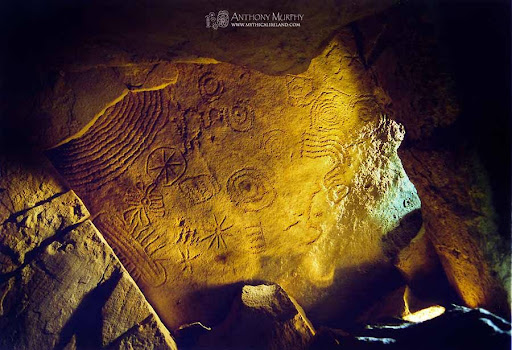
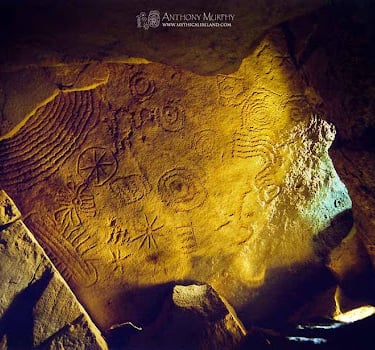
At the very back of Cairn T at Loughcrew
known as the Hag’s Cairn (Chair)
There is a famous stone that comes alive twice a year.
At sunrise on the equinoxes
It is bathed in a wash of golden light.
This wasn’t accidental; it was built with intention over 5,000 years ago by Neolithic farmers and sky watchers who understood the sun's movements with incredible precision.
They designed the space with incredible skill and care:
The chamber is oriented to capture that exact moment of light
Solar symbols are carved into the back stone
Everything is positioned so that, twice a year, the rising sun activates the space and the carvings illuminate.
That is an intensely devotional community, encoded in stone. And in just a few days, that alignment happens again.
Which makes today, St. Patrick's Day, with all its silly drunken reverie, feel a little strange, if you really think about it...
Because the energy building right now isn’t just about March 17th. It’s not just green beer, plastic shamrocks, or the story of Saint Patrick driving the 'snakes' (symbolic of the Pagan Folk) out of Ireland.
The world itself is preparing for something much older. The Spring Equinox. A moment that was tracked, honored, and quite literally built into the earth long before modern holidays took over the calendar.
Ireland never had native snakes. Historians are in pretty solid agreement on that. So when we hear that story, we’re not really talking about animals. The snakes were a metaphor for the land's older spiritual traditions. The druids. Earth-based practices rooted in season, sky, and place.
So when we talk about what was lost in that transition, we’re not being dramatic. We’re being precise.
There are people buried at Loughcrew who tracked the March sun with enough accuracy to build a chamber that still works perfectly thousands of years later. People who understood light, timing, and landscape in a way that feels almost impossible now. And their names are gone. Their work remains, but the culture that created it has largely been overwritten, including the holiday that now defines this week.
The Spring Equinox is one of the eight turning points on the Wheel of the Year. It marks the threshold between dark and light, the moment where day and night stand in balance before the year tips forward into regenerative growth and renewal.
And yet the celebration that dominates mid-March lands a few days early. It’s loud, it’s very green, and for the most part, it’s disconnected from what’s actually happening in the natural world.
Now, to be fair, the idea that St. Patrick’s Day was deliberately created to override the equinox is compelling, but not fully provable. What we can say with more confidence is something more layered.
The early Christian church in Ireland didn’t simply erase what came before it. It absorbed it.
existing festivals were repurposed
familiar symbols were reinterpreted
meaning was redirected rather than fully removed
It’s a smart strategy. Take what already holds meaning, reshape it, and carry it forward under a new name.
A few things we do know. Patrick’s feast day wasn’t placed on the official Catholic calendar until the 1600s, even though it had been observed informally for centuries. The actual dates of his life are uncertain, and there is no clear historical proof that he died on March 17th.
What is clear is that March 17th sits very close to the Spring Equinox.
And meanwhile, the chamber at Loughcrew continues to illuminate on schedule, exactly as it was designed to do. It doesn’t shift for narrative. It doesn’t adjust for tradition. It just follows the sun.
And the March holiday season doesn’t stop there...
Right behind St. Patrick’s Day comes Easter, which carries its own layered history. The Venerable Bede wrote of a goddess named Eostre, honored during a spring month called Eosturmonath. That name eventually became what we now call Easter, and it’s where the modern Wheel of the Year term Ostara comes from.
But it’s important to be accurate here. That tradition is Anglo-Saxon and Germanic, not Irish Celtic. The Celts didn’t formally celebrate Ostara as a named holiday, though they were deeply attuned to seasonal change.
What is consistent across cultures, though, is the pattern.
This window between mid-March and mid-April has long been recognized as a threshold. A time of return, renewal, and reemergence. You see it reflected in different traditions across the world:
The story of Attis, who was believed to die and return to life around the equinox
The Achaemenid Empire celebrated Nowruz, meaning “new day.”
Recurring seasonal rebirth themes across cultures and time periods
The Christian resurrection story didn’t invent this pattern. It stepped into something already ancient.
Even the name Eostre likely traces back further, connected to Eos and older Indo-European dawn archetypes. That’s a long lineage, and it shows up in the imagery that never fully changed.
Eggs. Hares. Green growth.
These symbols didn’t originate in Christianity. They persisted through it.
Then there’s the green itself, and the shamrock.
The significance of three in Ireland predates Christianity entirely. It shows up in how the world was understood: land, sea, sky. Cycles of life. Rhythms of nature. The Sacred Feminine...
The shamrock already carried meaning as a natural triad. It didn’t need to be explained. It already resonated. Which is exactly why it worked so well as a teaching tool.
Patrick didn’t invent its symbolism. He used it.
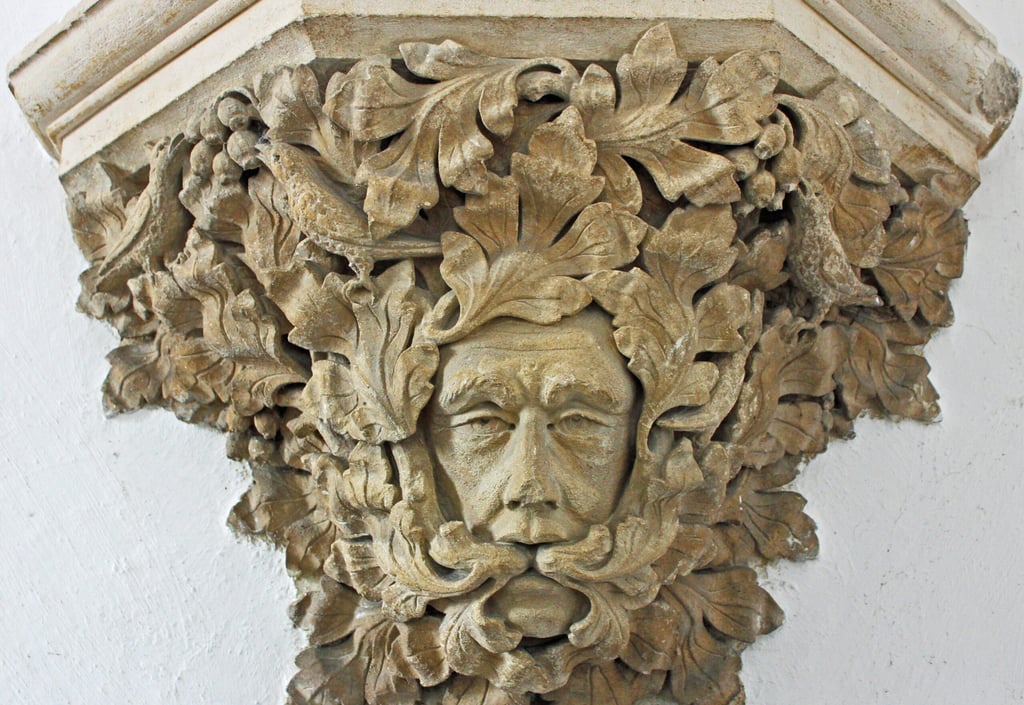
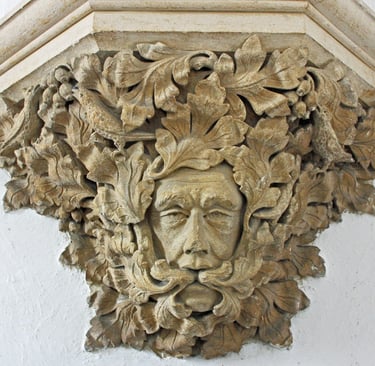
The Green Man, Jack-in-the-Green, Robin Hood, the King of May,
hidden in stonework across Europe.
A face of leaves and living earth,
Not erased
but absorbed into the architecture that came after...
And then there’s the Green Man. That foliate face carved into medieval churches across Europe, leaves spilling from his mouth, somewhere between human and forest. In Ireland, this figure echoes older relationships with land and nature, including deities like Cernunnos and traditions rooted in sacred groves and living landscapes.
He wasn’t erased. He was absorbed. Hidden in plain sight, carved into the very architecture that was meant to replace the worldview he came from.
In a lot of ways, March 17th feels like that too.
The green is still here.
The triad is still here.
The timing is still here.
The deeper layer didn’t disappear. It just changed form.
So here’s where I’ve landed with it.
I let St. Patrick’s Day be what it is. A cultural celebration with Irish roots that has been shaped by religion, history, and eventually turned into something highly commercial. I don’t feel the need to fight it.
But I also don’t let it override what I know is actually happening in this moment of the year.
Because just a few days later, the equinox arrives. And that shift is real, whether we acknowledge it or not.
And then, two weeks after that, we meet again.
The April 1st Full Moon lands deep in this seasonal turning, after the balance has reset and the light has begun to take hold again. It’s part of the same movement. Not separate from it.
If you’ve been in a long winter of any kind, this is where something begins to shift.
The people at Loughcrew felt that deeply enough to build a chamber that captures the light of this exact moment. And over 5,000 years later, it still works.
It never stopped mattering.
And if something in you is starting to stir right now, I’d pay attention to that.
I’ll see you there.
Join me April 1st for the Full Moon Circle on YouTube. Bring your altar, your questions, and whatever is beginning to rise.
With Love & Liberty
Jen Coombe ✨ alias ~ Jennadea